
Different Blood Group? Don’t Lose Hope!
Published on 26 Feb 2026
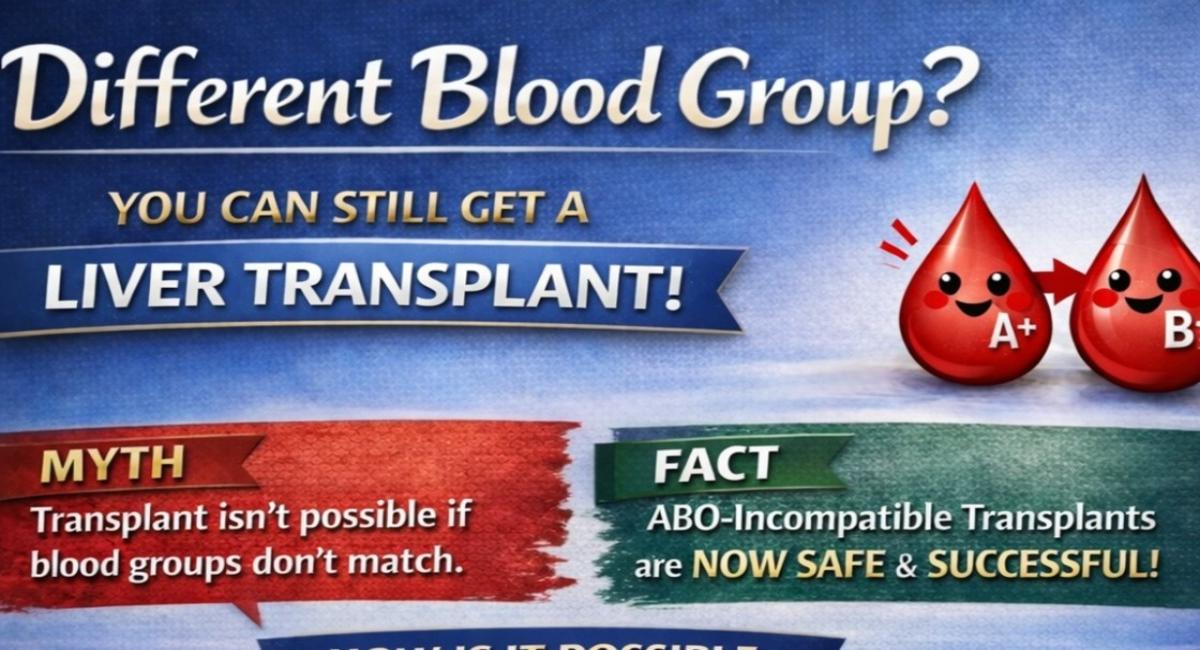
ABO-Incompatible Liver Transplants Are Now Safe & Successful
For decades, patients suffering from end-stage liver disease were told one painful truth: a liver transplant is only possible if the donor’s blood group matches the recipient. This limitation left thousands of patients waiting helplessly, even when a willing family donor was ready but had a different blood group.
Today, that reality has changed.
Thanks to remarkable advances in transplant medicine, ABO-incompatible liver transplantation has become a safe and life-saving option for patients across the world. A different blood group no longer means the end of hope—it can be the beginning of a new life.
Understanding Blood Groups and Transplant Rejection
Our blood group system (A, B, AB, and O) is determined by specific antigens present on red blood cells. When a person receives an organ from a donor with a different blood group, the immune system recognizes these antigens as “foreign” and produces antibodies that attack the transplanted liver.
In the past, this immune reaction caused rapid rejection and graft failure, making ABO-incompatible transplants nearly impossible.
However, modern medicine now focuses on removing or suppressing these antibodies before surgery, allowing the body to accept the new liver.
What Is an ABO-Incompatible Liver Transplant?
An ABO-incompatible liver transplant is a procedure in which the donor and recipient have different blood groups, but advanced medical protocols are used to prevent rejection.
This technique is especially useful for patients who:
-
Have no matching donor
-
Are critically ill
-
Cannot wait for a deceased donor liver
With proper preparation, these transplants now show survival rates comparable to compatible transplants.
Myth vs Fact
Myth:
A transplant isn’t possible if blood groups don’t match.
Fact:
With modern immunotherapy and blood purification techniques, ABO-incompatible liver transplants are now safe, effective, and widely practiced.
Thousands of patients worldwide have successfully undergone this procedure and are leading healthy lives.
How Is ABO-Incompatible Transplant Possible?
To protect the donor liver from immune attack, doctors follow a structured, three-step protocol:
1. Blocking Antibodies with Medication
Patients receive immunosuppressive drugs before surgery. These medications reduce the body’s ability to form harmful antibodies that attack the donor organ.
2. Removing Antibodies (Plasmapheresis)
Plasmapheresis is a blood-filtering procedure that removes anti-blood group antibodies from the bloodstream. This is done in multiple sessions before surgery until antibody levels become safe.
3. Protecting the Liver with IVIG
Intravenous Immunoglobulin (IVIG) is administered after plasmapheresis. It protects the transplanted liver by balancing the immune response and preventing sudden rejection.
This combined approach allows the body to safely accept a liver from a different blood group.
Who Can Benefit from ABO-Incompatible Transplant?
You may be a suitable candidate if:
-
You have end-stage liver disease
-
A family member is willing to donate
-
Your blood groups are different
-
Your health allows surgery and immunotherapy
This option is especially life-saving for patients with acute liver failure or rapidly worsening cirrhosis.
Success Rates and Safety
With experienced transplant teams, ABO-incompatible liver transplants now show excellent outcomes.
Studies have demonstrated:
-
Comparable survival rates to compatible transplants
-
Improved long-term liver function
-
Lower rejection rates due to advanced immunosuppression
What once seemed impossible is now a standard, safe procedure at specialized centers.
Why Time Matters in Liver Disease
Liver failure progresses silently but rapidly. Delaying a transplant while searching for a matching donor may allow the disease to worsen beyond recovery.
An ABO-incompatible transplant:
-
Reduces waiting time
-
Prevents complications
-
Improves survival chances
Early decision-making can truly save lives.
Life After Transplant
After surgery, patients follow a structured recovery plan that includes:
-
Regular blood tests
-
Imaging scans
-
Lifelong medications to prevent rejection
-
Healthy lifestyle changes
Most patients return to normal life, work, and family activities within months.
Expert Liver Transplant Care
Dr. Amit Jain
MS, MCh (GI Surgery)
Laparoscopic & Robotic GI Surgeon
Liver Transplant | GI Onco | Bariatric Surgery
Senior Consultant, Max Hospital, Patparganj, Delhi
With advanced training in liver surgery and transplantation, Dr. Amit Jain provides comprehensive care—from diagnosis to recovery.
Don’t Lose Hope
A different blood group no longer closes the door to life. With modern techniques, your family donor can still save you.
Book an Appointment: www.dramitgisurgeon.com